


Olivia A. Greene, PhD
Bio
Olivia grew up in South Florida, where her non-traditional path to astrophysics began with classical vocal training, visual arts, and musical theatre. Finding astronomy later in life, she built a foundation through diverse experiences: managing the cage of a casino boat, working as a paralegal in both personal injury and criminal defense, and performing on stage. Each role contributed essential skills—theatre fostered public speaking and audience reading; the casino developed quick math and accurate reporting; paralegal work instilled data reduction methods and formal writing. These experiences inform her approach to science communication and project management today.
In her second year of college, Olivia discovered astrophysics and found her calling. She earned her Bachelor's degree in Physics from The Harriett L. Wilkes Honors College at Florida Atlantic University, with minors in Mathematics and English Literature. She continued through Fisk University's Master's program via the prestigious Fisk-Vanderbilt Bridge Program, then completed her PhD in Astrophysics at Vanderbilt University, additionally earning a Multimessenger Astronomy Certificate through the EMIT program.
Her 339-page dissertation, "Seeing What Is, What Was, What Could Be, What Must Not: Refining, Cataloging, and Investigating A Complete, Spatially Resolved Spectrophotometric Sample of Nearby Post-Starburst E+A Galaxies in SDSS-IV MaNGA," represents the culmination of six years developing automated analysis tools and coordinating an international citizen science team. She successfully defended in October 2025.
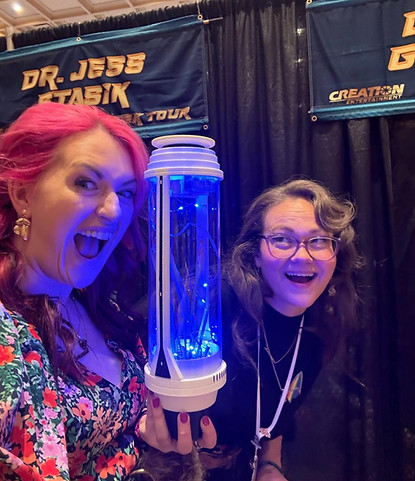
Beyond research, Olivia serves as Founding CFO and Director of Science Communication for The Neuroverse Initiative, a nonprofit she helped build from concept to 501(c)(3) status, with the incomparable Dr. Jessica Schonhut-Stasik (CEO). Together, they create programming that transforms how space sciences support neurodivergent individuals, organizing everything from neuroinclusive training workshops to public astronomy events at Star Trek conventions. Olivia has been featured in Nature Astronomy discussing advocacy in astronomy graduate programs and continues to shape inclusive practices across academic, industry, and entertainment sectors.
Olivia lives in Nashville with her husband, son, two cats and dog, where she continues developing tools for the astronomy community, building inclusive STEM programs, and reading 100+ books a year.




Research Focus
Olivia's research investigates galaxy evolution through spatially-resolved spectroscopy, with particular emphasis on post-starburst systems and the relationship between Active Galactic Nuclei (AGN) and rapid galaxy transformation. Working within the SDSS-IV MaNGA Survey, she developed the largest uniformly-selected catalog of E+A galaxies ever assembled—183 spatially-resolved systems with complete diagnostic measurements, morphological classifications, and equivalent width analyses.
The E+A Galaxy Project
Post-starburst E+A galaxies represent a critical evolutionary phase: systems that recently shut down star formation but retain strong Balmer absorption from their last generation of massive stars. These galaxies offer unique insights into quenching mechanisms and the role of AGN in galaxy evolution. Olivia's catalog provides the first comprehensive view of these systems using integral field spectroscopy, revealing spatial variations in stellar populations, ionization sources, and AGN activity that single-fiber surveys miss entirely.
To identify these rare systems among MaNGA's 10,000+ galaxies, Olivia led a citizen science initiative coordinating 27 researchers across three countries. The team visually classified candidates using spatially-resolved diagnostic maps (WHAN, BPT), producing a catalog that enables investigation of both central and off-nuclear AGN activity and its relationship with rapid post-starburst evolution.


Open-Access Tools
Olivia develops analysis pipelines that make cutting-edge astronomy accessible beyond large institutions:
MEWS (Measuring Equivalent Width in Spectra): An automated Python pipeline for accurate spectral line measurements, addressing systematic errors in existing tools through adaptive continuum fitting and smart profile selection. Validated against manual measurements for her 183-galaxy sample. Available on GitHub
Color-Mass Analysis Toolkit: Comprehensive suite for galaxy positioning in color-mass-magnitude space, featuring empirically-derived green valley boundaries and morphology integration.
Current Projects
Olivia is finalizing her catalog for publication (in preparation for The Astrophysical Journal), continuing tool development for spatially-resolved spectroscopy, and exploring opportunities to apply her expertise in pipeline development, science communication, and project management to advance astronomical research and public understanding of the universe.

Current Work

Education


Vanderbilt University | Nashville, TN
PhD in Astrophysics | 2020–2026
Advisor: Dr. Kelly Holley-Bockelmann | Co-Advisor: Dr. Charles T. Liu
Dissertation: "Seeing What Is, What Was, What Could Be, What Must Not: Refining, Cataloging, and Investigating A Complete, Spatially Resolved Spectrophotometric Sample of Nearby Post-Starburst E+A Galaxies in SDSS-IV MaNGA"
PhD conferral: May 8, 2026
Awarded Robert T. Lagemann Award for exceptional promise in physics (2021)
Fisk University | Nashville, TN
MS in Physics, Summa Cum Laude | 2017–2020
Fisk-Vanderbilt Bridge Program
Florida Atlantic University | Jupiter, FL
BS in Physics | 2013–2017
The Harriet L. Wilkes Honors College
Minors: Mathematics and English Literature